What if your production floor knew something about your business that you didn’t? A machine stops for three minutes. A pallet moves through inspection with a minor defect. A production line falls behind schedule, but no one realizes how far behind until the end of the shift.
Individually, these moments may seem insignificant. Over weeks and months, however, they can reveal costly patterns that traditional reporting methods often miss. Artificial intelligence is giving pallet manufacturers a new way to see what’s happening inside their operations. By combining industrial cameras, machine vision, and real-time data analysis, companies can measure production, identify recurring problems, and make more informed decisions without necessarily replacing their existing equipment.
Recent developments from technology providers such as Zira demonstrate how AI is moving beyond experimental applications and into everyday pallet manufacturing operations.
The Production Floor Has More to Tell Us
For decades, pallet manufacturers have relied on experienced employees, manual production counts, and end-of-shift reports to evaluate performance. These methods provide useful information, but they don’t always capture the full picture. Consider a production line that consistently misses its daily target. A supervisor might assume the equipment is running too slowly or that employees need additional training. Without accurate information about production interruptions, however, the actual cause can remain hidden.
Perhaps the line experiences several short stoppages throughout the day. Maybe material isn’t arriving quickly enough, or completed pallets are accumulating faster than forklifts can remove them. AI-powered monitoring systems can help identify these patterns by observing production activity and recording information as it happens.
For example, Zira’s camera-based technology can track pallet counts, equipment uptime, and production interruptions. Custom Forest Products in South Carolina has used the technology to gain better visibility into downtime and identify opportunities for operational improvement.
The value comes from understanding why production slows down and having the information needed to address the underlying cause.

When a Camera Becomes a Quality Control Tool
A camera on a manufacturing floor once served primarily as a security or monitoring device. Artificial intelligence is expanding what that same equipment can accomplish. Modern machine vision systems can be trained to recognize specific objects, measurements, and defects. In pallet manufacturing, this means cameras can evaluate finished pallets for missing boards, protruding nails, improper spacing, and other visible quality concerns.
Depending on the application, multiple cameras may be necessary to inspect different angles or areas that a single camera cannot see. What makes this technology particularly valuable is its ability to apply defined inspection criteria repeatedly throughout production. Human inspectors bring experience and judgment that remain essential, but fatigue, production speed, and changing conditions can make consistent inspection challenging. Properly configured AI systems can support inspection teams by identifying visible defects and recording the results for further review.
Companies such as Hinton Lumber and McVantage Packaging are already using Zira’s technology for pallet quality monitoring and recycled pallet grading. These applications demonstrate how machine vision can support both new pallet manufacturing and recycling operations. For customers, improved quality control can mean greater consistency in the pallets they receive and fewer unexpected problems during handling and transportation.

Why Better Pallet Quality
Matters to Automated Warehouses
A pallet that performs adequately in a traditional warehouse may create problems in a highly automated facility. Automated storage and retrieval systems, conveyors, and robotic material handling equipment often depend on consistent pallet dimensions and structural conditions. A warped board, damaged stringer, or protruding nail can interfere with equipment designed to move loads through tightly controlled processes.
When a pallet causes a conveyor jam or interrupts an automated storage system, the consequences can extend well beyond replacing the damaged pallet. Operations may experience downtime, additional handling costs, delayed shipments, or product damage.
This is one reason pallet inspection technology is becoming increasingly relevant to manufacturers and distributors. As businesses invest in warehouse automation, the pallets supporting their products must meet the requirements of those systems. More consistent inspection practices can help suppliers identify potential problems before pallets reach the customer’s facility.
The growing connection between pallet quality and warehouse automation also changes how businesses should evaluate their pallet purchasing decisions. Price remains important, but dimensional consistency, load requirements, and dependable quality deserve equal consideration.

AI Is Helping Manufacturers Find the Real Bottleneck
Producing more pallets doesn’t automatically make an operation more efficient. Imagine a facility that invests in a faster nailing machine, only to discover that its existing material handling equipment cannot keep up with the increased output.
The production line may be capable of manufacturing more pallets, but the overall operation remains limited by how quickly finished products can be moved and stored. This is where real-time production data becomes especially valuable.
By monitoring equipment activity, production counts, and downtime, manufacturers can identify which processes are actually restricting output. In some cases, the solution may involve adjusting workflow, improving material availability, or changing how employees and equipment are scheduled. Georgetown Pallet reported significant productivity improvements after implementing Zira’s monitoring technology, with production increasing enough to create new demands on forklift operations.
That example illustrates an important lesson. Improving one part of a manufacturing process can reveal limitations elsewhere. The goal is to understand how the entire operation works together so improvements deliver measurable results.

From Production Counts to Smarter Business Decisions
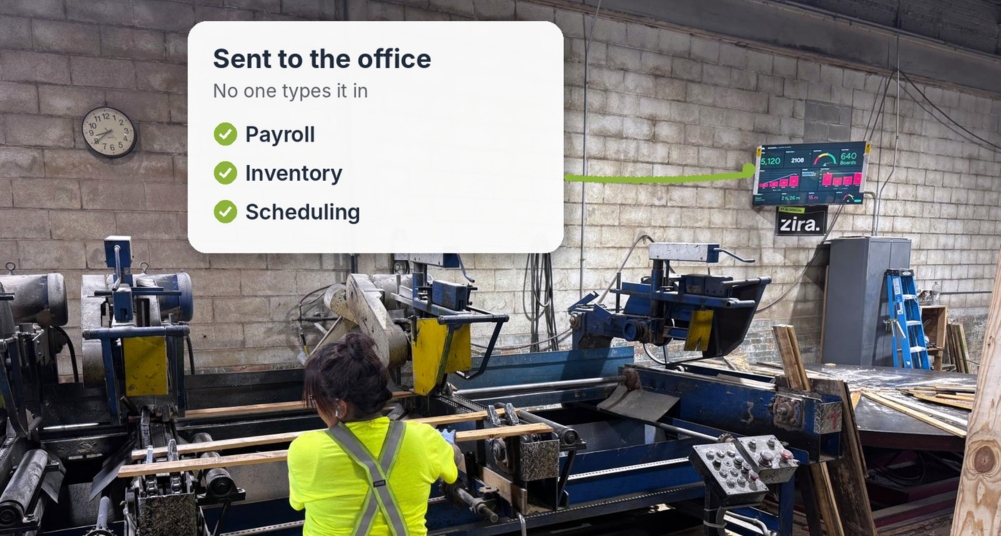
One of the most promising applications of AI in pallet manufacturing involves connecting production activity with business management systems. Traditionally, information moves between the production floor and front office through handwritten records, spreadsheets, or manual data entry. Employees record how many pallets were produced, update inventory, and communicate completed orders to administrative staff.
Each additional step creates opportunities for delays or errors. Connected monitoring systems can reduce that burden by automatically capturing production information and making it available to other business applications.
When a pallet is completed, for example, a connected system could update production totals, adjust inventory records, and associate the finished product with a customer order. Managers could then use that information to evaluate scheduling, material requirements, and order fulfillment. Emerging AI tools are also making operational information easier to access. Instead of searching through multiple reports, managers may be able to ask questions about production performance and receive answers drawn from recorded plant data.
This creates opportunities for more informed decisions throughout the business, particularly when production, purchasing, inventory, and customer service teams are working from consistent information.
Could Every Pallet Have Its Own Digital History?
Imagine receiving a shipment of pallets with access to information about when each pallet was manufactured, which production line assembled it, and what quality checks it passed. That level of traceability could eventually become possible through advances in AI-powered inspection and digital record keeping.
Zira is exploring visual fingerprinting technology that could recognize individual pallets using characteristics such as wood grain, nail patterns, and board imperfections. The concept would potentially allow pallets to be identified without relying exclusively on physical labels, barcodes, or RFID tags.
The technology remains a developing possibility rather than an established industry standard. Still, the implications are worth considering. For manufacturers, individual pallet records could support quality investigations and improve production accountability. For distributors and warehouse operators, greater traceability could make it easier to understand the history of pallets moving through their facilities.
As supply chains become increasingly data-driven, the ability to document pallet quality may become an important consideration in supplier relationships.
Technology Works Best When People Understand the Process
Artificial intelligence can identify patterns, count products, and flag potential problems. It cannot independently understand every operational challenge or make every decision required to run a successful manufacturing facility. That still requires experienced people. An AI system may identify repeated downtime on a production line, but employees must investigate whether the problem involves equipment maintenance, material availability, production scheduling, or another cause.
The strongest applications of manufacturing technology combine accurate information with the practical knowledge of the people who work with the equipment every day. Successful implementation also requires attention to camera placement, lighting, system configuration, and ongoing validation. These details affect the accuracy and usefulness of the information being collected.
For pallet manufacturers considering AI, starting with a single production problem may be more practical than attempting to automate an entire facility at once. A company might begin by monitoring downtime on one line, evaluating the accuracy of production counts, or testing automated quality inspection. The results can help determine whether additional investment makes financial and operational sense.
What This Means for Manufacturers and Distributors
Although much of this technology operates behind the scenes, its potential benefits extend directly to the businesses purchasing and using pallets. Better production visibility can help pallet manufacturers plan more accurately and respond to changing order volumes. More consistent quality inspection can reduce the likelihood of defective pallets entering the supply chain. Improved inventory tracking can support dependable fulfillment and communication.
For warehouse managers and logistics professionals, these improvements matter because pallet performance influences everything from product protection to material handling efficiency. Businesses should also consider how their own operations are evolving. A company planning to introduce automated conveyors, high-density storage, or robotic handling equipment may need to revisit its pallet specifications before implementing those systems.
Working with a knowledgeable pallet supplier can help identify the appropriate pallet dimensions, construction requirements, and handling considerations for the application.
The Future of Pallet Manufacturing Starts with Better Information
Artificial intelligence is creating new opportunities throughout the pallet industry, but some of its most valuable applications are surprisingly practical. Knowing how many pallets were produced. Understanding why equipment stopped. Identifying defects before shipment. Recognizing where time and materials are being wasted. These are everyday operational questions that manufacturers have always needed to answer. AI is simply providing new ways to answer them with greater consistency and detail.
At Newnan Pallet Company, we recognize the importance of dependable products, knowledgeable service, and continuous improvement throughout the supply chain. As manufacturing technology advances, the fundamentals remain essential: quality materials, reliable processes, and pallets suited to the demands of the businesses that depend on them.
For manufacturers, distributors, and warehouse operators, the future of pallet manufacturing will be shaped by how effectively companies turn better information into better decisions.