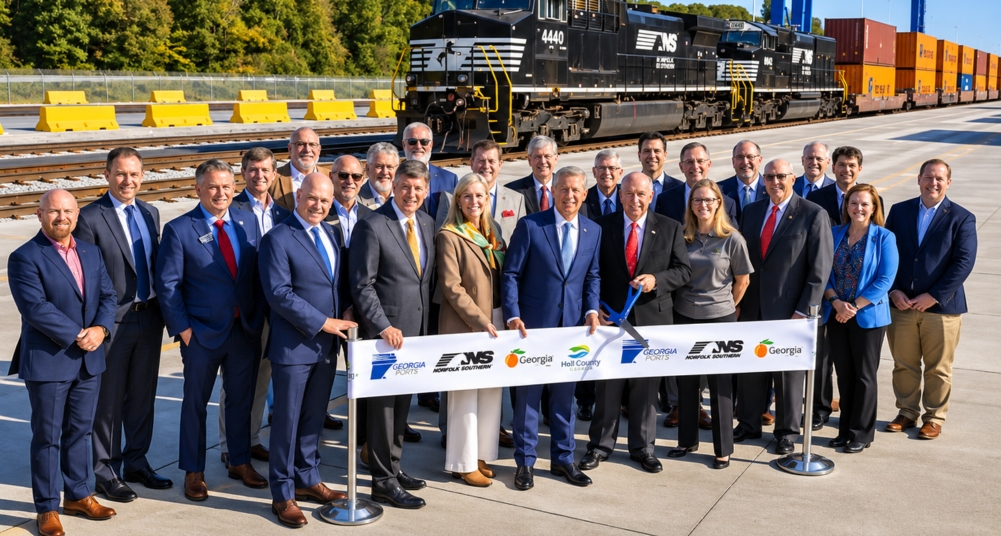
Georgia Gov. Brian Kemp welcomed port customers, local dignitaries and industry leaders to the grand opening of Georgia Ports Authority’s Gainesville Inland Port on Oct. 29. (Georgia Ports Authority)
What if easing Atlanta’s freight congestion didn’t require building another highway? That question is at the center of Georgia’s latest investment in transportation infrastructure.
For manufacturers and distributors moving products across the state, traffic congestion creates more than frustrating commutes. It affects delivery schedules, transportation costs, warehouse operations, and the reliability of the entire supply chain. Now, a new inland port in Gainesville, Georgia, is offering an alternative to moving every shipping container by truck through metro Atlanta.
The Gainesville Inland Port, officially opened in May 2026 and celebrated with a grand-opening ceremony on October 29, represents a $134 million investment in Georgia’s freight transportation network. By connecting Northeast Georgia directly to the Port of Savannah through rail service, the facility could change how businesses move cargo between inland manufacturing centers and international markets.
A New Connection Between Northeast Georgia and the Port of Savannah
Georgia has spent years strengthening its position as a major logistics and distribution hub. The Port of Savannah plays a central role in that strategy, connecting manufacturers, retailers, and distributors to global shipping networks.
But getting freight between the coast and inland facilities presents its own challenges. Traditionally, many shipping containers have traveled by truck along Georgia’s interstate highways, adding to traffic through already congested transportation corridors.
The Gainesville Inland Port introduces another option. Operated by the Georgia Ports Authority, the facility provides direct rail service through Norfolk Southern between Gainesville and Savannah five days a week. With an annual capacity of 200,000 container units, the terminal is designed to support growing freight activity across Northeast Georgia.
Instead of relying exclusively on long-distance trucking, participating businesses can move containers by rail for the longer portion of their journey and use trucks for local transportation between the inland terminal and nearby facilities. This approach, known as intermodal transportation, allows businesses to combine the advantages of rail and trucking within a single freight movement.
Could 26,000 Fewer Truck Trips Make a Difference?
One of the most notable projections associated with the new inland port involves highway congestion. According to Georgia Ports Authority officials, the Gainesville facility could eliminate approximately 26,000 truck trips from Atlanta-area and Hall County roads during its first year of operation.
That figure is a projection, and the actual impact will depend on how many businesses use the terminal and how freight volumes develop. Still, the potential is significant. Each container transported by rail instead of making the full highway journey can reduce demand for long-distance trucking along the affected route. Georgia Ports officials estimate that the alternative could avoid a roughly 600-mile round trip by truck between the Savannah area and Northeast Georgia.
For businesses operating throughout metro Atlanta, even modest improvements in freight movement could have practical benefits. Less congestion along major freight corridors may contribute to more predictable transit times, fewer transportation disruptions, and better scheduling opportunities.
However, the benefits will not be distributed evenly. Businesses located near the Gainesville terminal and those with suitable container volumes are more likely to benefit directly than companies operating outside its primary service area.
Why Transportation Infrastructure Matters to Manufacturers
Manufacturing efficiency doesn’t end when a product leaves the production line. Finished goods still need to be packaged, loaded, transported, stored, and delivered. Every stage depends on the coordination of materials, equipment, transportation providers, and people.
When freight transportation becomes unpredictable, those carefully planned processes can be disrupted. A delayed container may affect production schedules if it contains essential materials. A late outbound shipment can create additional storage requirements or interfere with a customer’s receiving schedule.
Improved access to rail transportation gives eligible manufacturers another option for managing those risks. For Northeast Georgia businesses importing raw materials or exporting finished products through Savannah, the Gainesville Inland Port could create opportunities to evaluate different freight routes and transportation arrangements.
The practical value will depend on shipment frequency, container volumes, rail schedules, trucking requirements, and total transportation costs. Nevertheless, expanding the available options gives businesses greater flexibility when planning their supply chains.
The Connection Between Freight Growth and Pallet Demand
Shipping containers and wooden pallets serve different purposes, but both are essential components of modern freight transportation. Containers make it possible to move large quantities of cargo through international shipping networks. Pallets support the handling, storage, and movement of many products within warehouses, manufacturing facilities, and distribution centers. As Georgia expands its freight infrastructure, businesses must consider how their internal material handling operations support that larger transportation network.
For example, a manufacturer receiving imported materials may need to unload containers, organize products onto pallets, and move those materials into warehouse storage or production. Similarly, a distributor preparing outbound shipments must ensure that products are packaged and palletized appropriately for their next destination. These processes depend on pallets that meet the load requirements, dimensions, and handling conditions of the operation.
Inconsistent pallet quality can create problems during forklift handling, warehouse storage, and transportation. Damaged boards, unstable loads, or unsuitable pallet designs can increase the risk of product damage and operational delays.
The Gainesville Inland Port does not automatically mean higher pallet demand across Georgia. However, investments that improve freight connectivity can support industrial activity, which makes reliable pallet supply an important consideration for manufacturers and distributors planning for growth.
Freight Efficiency Begins Before the Truck Arrives
Transportation improvements receive considerable attention because their impact is easy to recognize. A container moves by rail instead of truck. A shipment avoids a congested highway. A business gains another connection to a major seaport.
But the efficiency of the overall supply chain also depends on what happens inside individual facilities. A shipment that arrives on schedule can still experience delays if a warehouse isn’t prepared to receive it. Finished products may be ready for distribution, but inadequate pallet inventory or unsuitable load configurations can slow the loading process. This is why businesses benefit from examining freight transportation and material handling together.
Pallet specifications should reflect the products being transported, the equipment used to move them, and the conditions they will encounter throughout storage and distribution. For operations using automated handling equipment, consistent dimensions and structural performance become especially important. Manufacturers and distributors that coordinate transportation planning with packaging, pallet purchasing, and warehouse operations are better positioned to take advantage of improvements in Georgia’s freight network.
Georgia Is Building a More Connected Logistics Network
The Gainesville Inland Port is part of a larger investment strategy. Georgia Ports Authority has outlined a $5 billion, 10-year expansion plan involving port infrastructure in Savannah and Brunswick, along with additional improvements to the state’s freight network. The Gainesville facility also builds on Georgia’s existing inland port strategy, which includes the Appalachian Regional Port in Northwest Georgia.
Together, these investments reflect an effort to connect inland manufacturing and distribution centers with coastal shipping facilities more efficiently. For businesses evaluating where to manufacture, store, or distribute products, transportation infrastructure is an important consideration. Access to major highways, rail service, seaports, and regional distribution networks can influence transportation costs, delivery capabilities, and long-term operating decisions. Georgia’s continued investment in these connections may strengthen the state’s appeal to companies that depend on efficient movement of goods.
What Georgia Businesses Should Be Watching
The Gainesville Inland Port is now operational, but its long-term impact will become clearer as freight volumes increase and businesses incorporate the facility into their transportation plans. Manufacturers and distributors should pay attention to how rail service develops, whether the projected reductions in truck traffic materialize, and how additional freight options affect transportation costs and scheduling.
Businesses should also evaluate whether their current warehouse and material handling processes can support changing shipment patterns. A more connected transportation network creates opportunities, but companies still need dependable internal operations to make the most of them. For businesses throughout Georgia, that includes maintaining reliable access to the pallets and packaging materials that support daily production and distribution.
__________________________________
Georgia’s newest inland port represents more than another transportation facility. It reflects a broader effort to improve how goods move between manufacturing centers, distribution facilities, and international shipping networks. With direct rail service to Savannah and the potential to reduce thousands of long-distance truck trips, the Gainesville Inland Port could become an important part of Northeast Georgia’s logistics infrastructure.
At Newnan Pallet Company, we understand that reliable supply chains depend on the coordination of transportation, warehousing, and material handling. As Georgia continues investing in its logistics network, businesses will need dependable pallet solutions that support efficient storage, handling, and shipment of their products.
Looking for a reliable pallet supplier in Georgia? Contact Newnan Pallet Company to discuss your pallet requirements and how the right pallet solutions can support your manufacturing or distribution operation.